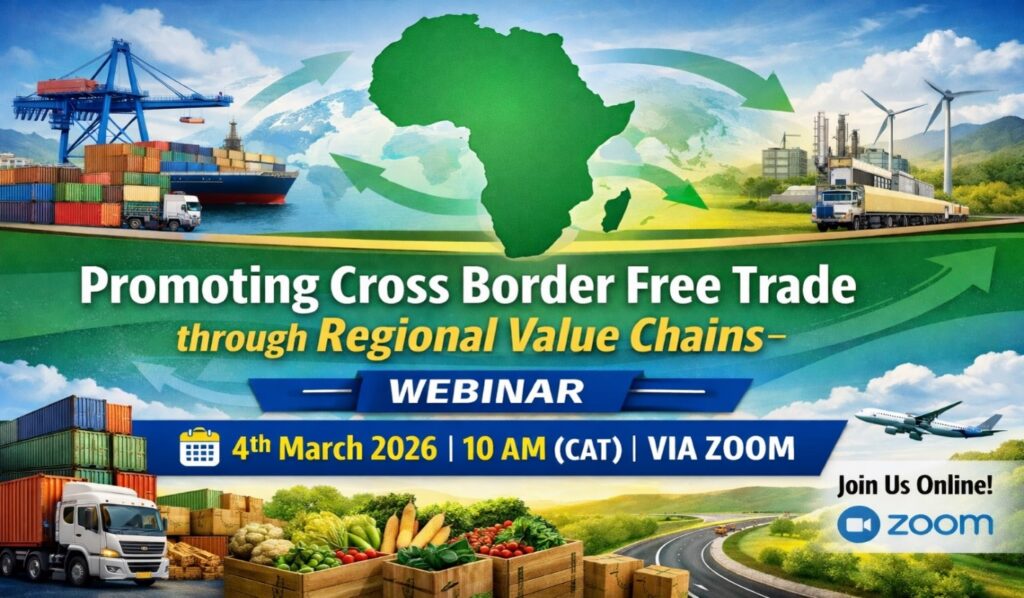
The COMESA Business Council (CBC) hosted a webinar in partnership with Coca-Cola Africa on “Promoting Cross-Border Free Trade through Regional Value Chains” The session brought together stakeholders from the public and private sectors, including the World Economic Forum and the Global Alliance for Trade Facilitation. At a time when intra-regional trade remains well below its potential, the discussion offered a practical look at what it takes to make regional trade work on the ground.
The central message was straightforward: regional value chains are the mechanism that turns trade agreements into tangible business outcomes. Without them, the COMESA Free Trade Area remains a political commitment rather than a commercial reality, particularly for the small and medium enterprises that make up most of the economic activity across the region.
A significant part of the discussion focused on trade facilitation tools that exist today but remain underused. The Simplified Trade Regime and the Electronic Certificate of Origin were highlighted as two mechanisms that can meaningfully reduce the time and cost of cross-border transactions, especially for small-scale traders. The opportunity is not to create new frameworks but to drive wider adoption of the ones already in place.
One of the most insightful contributions came from a study of the mango value chain in East Africa, presented by Chris Holden, Programme Manager at the International Chamber of Commerce for the Global Alliance for Trade Facilitation. The findings were practical and specific: better customs integration, more consistent standards across borders, and clearer processes for resolving trade barriers would significantly improve market access and reduce post-harvest losses for producers. The study was a useful reminder that the barriers to regional trade are rarely abstract; they are specific, identifiable, and addressable.
Mariam Soumaré, Knowledge and Community Lead at the Global Alliance for Trade Facilitation and the World Economic Forum, outlined how ongoing efforts to advance AfCFTA implementation are focusing on exactly this kind of practical progress. Digitizing trade processes, simplifying border procedures, and building the public-private collaboration needed to move from policy to execution are the priorities.
The webinar also highlighted the contribution of private sector actors in supporting regional trade development. The Coca-Cola system also highlighted its role in Africa’s long-term growth and sustainable development across the continent. Referring to its recently launched socio-economic impact study, it demonstrated how the Coca-Cola system drives production, generates income, and supports employment across a wide range of industries and geographies.
In conclusion, The COMESA Business Council (CBC) reaffirmed its commitment to strengthening regional value chains and will continue to facilitate cross-sector dialogue that translates discussions into concrete action. The Mango Value Chain report is set to be launched during the upcoming Biashara event, further contributing to this agenda.