
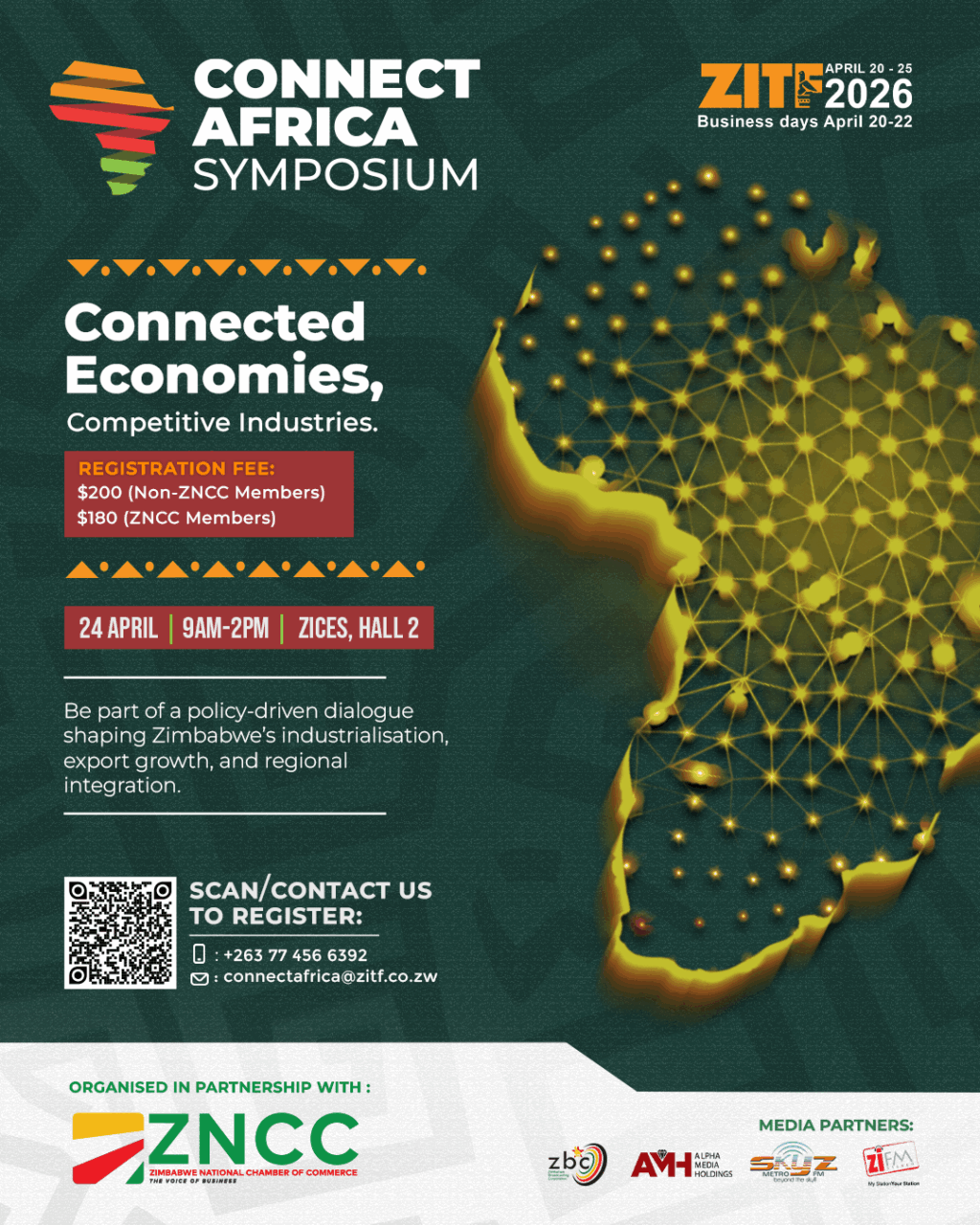
The Zimbabwe National Chamber of Commerce (ZNCC), in partnership with the Zimbabwe International Trade Fair (ZITF), will host the Connect Africa Symposium on 23 April 2026 in Bulawayo, during the 66th Edition of the Zimbabwe International Trade Fair under the theme “Connected Economies, Competitive Industries.” The Symposium is being repositioned from a conventional dialogue forum into a structured, results-oriented platform focused on trade facilitation, industrial collaboration, and private sector-led integration across the African continent.
This repositioning is deliberate. Africa’s integration agenda has matured at the level of policy design, but outcomes remain constrained. The African Continental Free Trade Area (AfCFTA) created a market of over 1.3 billion people with a combined GDP of approximately US$3.4 trillion. Yet intra-African trade continues to range between 14 and 18 percent of total trade, significantly below Asia and Europe. The Common Market for Eastern and Southern Africa (COMESA) is a market of over 600 million people and intra-regional trade is below 15%. This gap is not simply a function of tariffs. It reflects structural constraints in production, logistics, standards, and financing. It also reflects a persistent disconnect between trade agreements and firm-level participation.
The Connect Africa Symposium is designed to interrogate this gap directly. It is anchored on a simple premise. Trade agreements do not trade. Firms do. The central question is, therefore, not whether Africa has the right frameworks, but whether its enterprises are positioned to utilise them effectively.
For COMESA Member States and their partners, this question is particularly relevant. The COMESA region has made progress in tariff liberalisation and trade facilitation, yet non-tariff barriers, regulatory divergence, and limited productive complementarity continue to constrain intra-regional trade expansion. While regional protocols exist, the cost of moving goods across borders, complying with standards, and accessing market information remains high for many firms, particularly small and medium enterprises.
Zimbabwe provides a useful case study within this broader regional context. The country sits at a strategic intersection of COMESA, SADC, and the AfCFTA, positioning it as a potential trade and logistics hub for Southern and Eastern Africa. However, this geographic advantage has not fully translated into trade competitiveness. Export performance remains concentrated in primary commodities, with limited diversification into higher value-added manufacturing. This pattern mirrors wider continental trends, where commodity exports dominate and industrial depth remains shallow.
The implications are clear. Without structural transformation in production, trade integration will remain shallow. Preferential access to markets does not automatically generate exports. Firms must be competitive, compliant, and connected to regional value chains. This requires coordinated action across trade policy, industrial policy, infrastructure development, and enterprise support systems.
Recent policy developments in Zimbabwe illustrate both the direction of travel and the complexity of implementation. The Government’s decision in February 2026 to ban the export of raw minerals reflects a strategic shift toward domestic value addition and resource beneficiation. The policy seeks to retain value within the economy, stimulate industrial investment, and move Zimbabwe up the value chain in the global minerals economy. However, such measures also raise important questions about policy coherence within regional and continental frameworks. Export controls, while aligned with industrialisation objectives, must be assessed against commitments under AfCFTA and regional trade agreements like COMESA, as well as their impact on investor confidence and supply chain integration.
This tension is not unique to Zimbabwe. Across the continent, governments are increasingly adopting industrial policy instruments aimed at strengthening domestic production. At the same time, they remain signatories to trade agreements that emphasise liberalisation and market access. The challenge lies in balancing these objectives in a manner that supports competitiveness rather than constrains it.
The Connect Africa Symposium creates a platform to examine these issues in a structured and practical manner. It moves beyond generalised discussions of integration to focus on how policy choices affect real trade outcomes. This includes examining the utilisation of trade agreements such as the AfCFTA, COMESA protocols, SADC frameworks, and the EU–Eastern and Southern Africa Economic Partnership Agreements (EU-ESA EPAs). While these agreements offer preferential access, utilisation rates remain uneven, often due to limited awareness, compliance challenges, and supply-side constraints.
The Symposium will also engage with emerging global dynamics that are reshaping trade. The current global environment is characterised by a resurgence of protectionism, increased use of tariffs and subsidies, and strategic competition among major economies. Supply chains are being reconfigured around resilience and geopolitical considerations rather than cost efficiency alone. For African economies, this creates both risks and opportunities. On one hand, access to traditional export markets may become more uncertain. On the other, there is potential to reposition within regional and alternative global value chains.
Within this context, the role of regional economic communities such as COMESA becomes more critical. These platforms are not only vehicles for market integration but also mechanisms for coordinating industrial policy, standards, and trade facilitation measures. The effectiveness of these institutions will depend on their ability to translate agreements into practical outcomes for businesses operating within their jurisdictions.
A central feature of the 2026 Connect Africa Symposium and the wider ZITF platform is the deliberate shift toward transactional engagement. The introduction of structured business-to-business (B2B) and business-to-government (B2G) matchmaking is intended to address one of the key weaknesses of past engagements, the absence of measurable outcomes. Delegates will be profiled, matched based on sector alignment and market interests, and supported through facilitated interactions. This approach is designed to generate trade leads, partnerships, and investment opportunities that extend beyond the event itself.
In parallel, the Symposium will integrate export development efforts through collaboration with organizations like ZimTrade and the Zimbabwe Investment and Development Agency (ZIDA). Export-ready enterprises will be identified and positioned to engage with regional buyers, ensuring that the platform is anchored in real commercial activity. This is a critical shift. Trade promotion must move from generic exposure to targeted market linkage. Without this, the gap between policy ambition and business reality will persist.
The ZITF also recognises the importance of ecosystem engagement. Rather than being confined to a single venue, the Symposium will be embedded within a broader set of activities across Bulawayo during ZITF week. These include sector tours, industrial visits, innovation showcases, and SME cluster engagements. This approach allows delegates to interact directly with production systems, understand local capabilities, and identify partnership opportunities. It also strengthens the linkage between trade dialogue and industrial reality.
Another important dimension is the integration of youth into the trade and industrialisation agenda. The inclusion of a dedicated Youth Connect platform reflects a recognition that Africa’s demographic structure must be leveraged productively. Young entrepreneurs and innovators are already active in digital services, fintech, creative industries, and emerging sectors. However, their participation in formal trade systems remains limited. The Symposium aims to create a structured interface between youth-led enterprises, policymakers, and investors, with a focus on scaling participation in regional value chains.
For COMESA Business Council members like the ZNCC, the Connect Africa Symposium presents a practical opportunity to strengthen collaboration across the region adding to the Annual COMESA Business Forums. Chambers of Commerce play a critical role in bridging policy and enterprise. They are positioned to mobilise firms, disseminate market information, and facilitate business linkages. The Symposium provides a platform for these institutions to engage directly, share experiences, and identify areas for joint action.
The strategic importance of the Symposium also lies in its timing. Zimbabwe is transitioning from National Development Strategy 1 to National Development Strategy 2, with a stronger emphasis on industrial scale-up, export competitiveness, and regional integration. The policy direction is clear. The challenge is execution. Platforms that bring together policymakers and the private sector in a structured, outcome-focused manner are essential for translating strategy into results.
At a broader level, the Connect Africa Symposium reflects an evolving understanding of what integration requires. It is no longer sufficient to negotiate agreements and reduce tariffs. Integration must be built through production linkages, logistics efficiency, regulatory alignment, and enterprise capability. It must be driven by firms that can compete, comply, and connect across markets.
The 2026 edition signals a shift toward this model. It positions the Symposium not as an isolated event, but as part of a broader effort to strengthen Africa’s economic integration through practical engagement. It recognises that the success of frameworks such as AfCFTA will depend on the extent to which they are utilised by businesses on the ground.
For COMESA Member States and partners, the message is clear. The opportunity for intra-African trade exists, but it requires deliberate action. Policy frameworks must be matched by implementation capacity. Market access must be matched by production capability. Dialogue must be matched by transaction.
The Connect Africa Symposium 2026 is designed to contribute to this transition. It is a platform where trade policy meets industrial strategy, where regional commitments are tested against business realities, and where integration is pursued not as an aspiration, but as an economic imperative.
Article by the Zimbabwe National Chamber of Commerce (ZNCC) a CBC National Focal Point