
Article By Oussama Ben Khelifa-TUNISIA
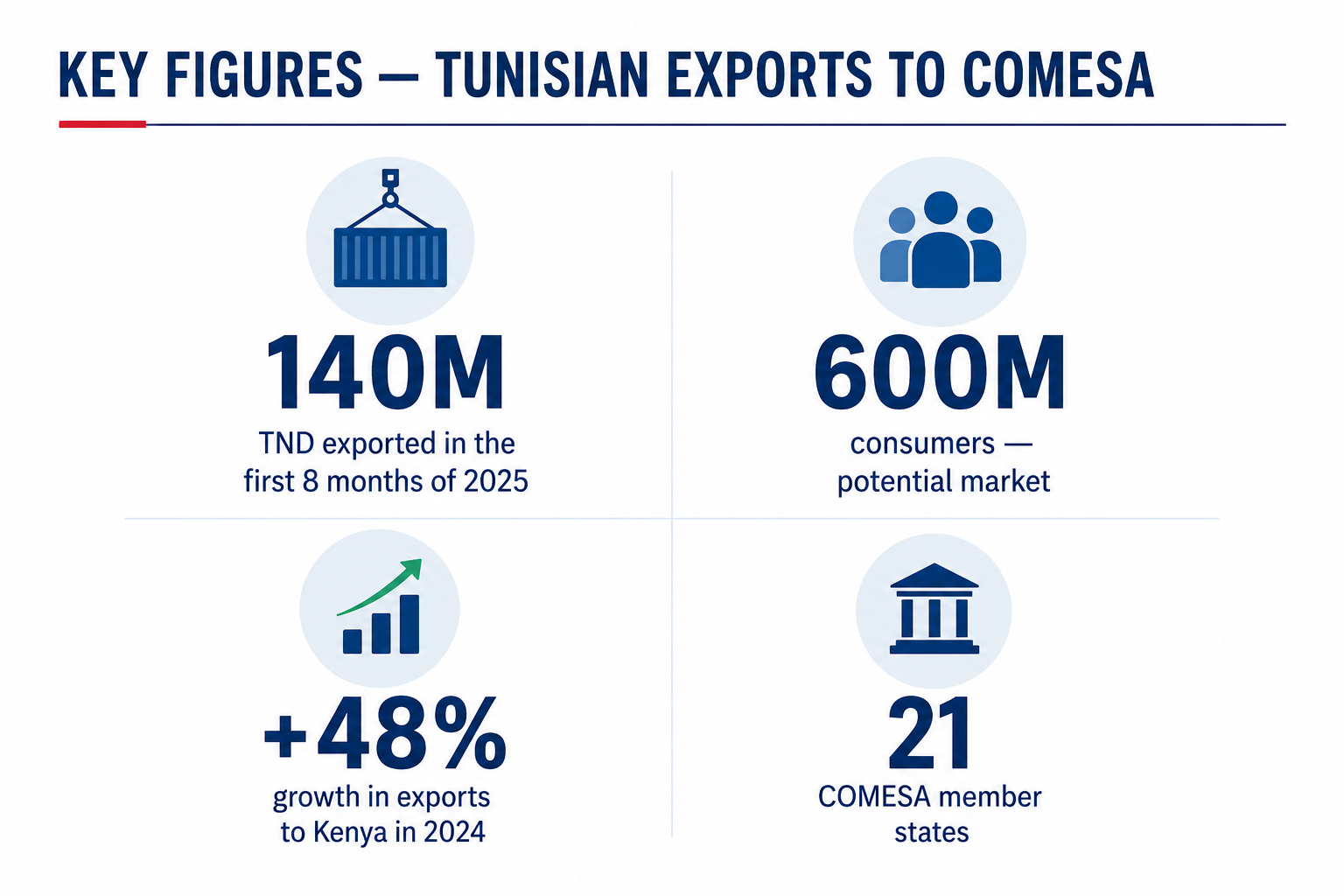
Five years after joining the COMESA Free Trade Area, Tunisia is returning to growth in this market of 600 million consumers. A new study by our consultant from the Tunis Chamber of Commerce and Industry reveals encouraging signals — and structural challenges that should not be underestimated.
East and Southern Africa is no longer a distant frontier for Tunisian exporters. Since Tunisia’s official accession to the Common Market for Eastern and Southern Africa (COMESA) in June 2019, and the entry into force of access to the Free Trade Area (FTA) in January 2020, a new chapter has opened in the country’s trade relations. A technical workshop held on 12 February 2026, analysing Tunisian exports to COMESA member states between 2022 and 2025, has just produced a nuanced assessment rich in insights.
A high-potential economic space, still under-exploited
Bringing together 21 member states across 12 million km², COMESA stands out for its ambition: to become a fully integrated, globally competitive economic community. For Tunisia, membership in this bloc represents a considerable tariff advantage. Products of Tunisian origin benefit from full exemption from customs duties on entry into member states that have ratified the FTA. In practice, this makes Tunisian goods between 20% and 30% cheaper than those of competitors outside the zone, whether Asian or European.
COMESA’s preferential rule of origin — which requires at least 35% local value added — remains relatively accessible for Tunisian industry, provided certification procedures are mastered, an area where the CCIT plays a decisive supporting role.
Top 5 export sectors to COMESA (2024)
› Machinery and mechanical appliances (ch. 84) — TND 128.8M
› Electrical equipment (ch. 85) — TND 73.8M
› Articles of iron and steel (ch. 73) — TND 54.7M
› Cereal preparations (ch. 19) — TND 53M
› Salt, sulphur, cement (ch. 25) — TND 52.9M
“Tunisian products can be exported to member states with a 100% reduction in customs tariffs — a major competitive advantage over exporters from outside the zone.”
Three turbulent years, but signs of recovery
Analysis of Tunisian exports between 2022 and 2024 traces a jagged trajectory, highly uneven across markets. While the overall trend points to recovery after a trough in 2023, performance varies considerably from one country to another.
Uganda alone is revealing of the fragility of these trade flows. After peaking at 90.2 million dinars in 2022 — making it Tunisia’s leading partner in absolute value — Tunisian exports to the country collapsed to 20 million dinars in 2023, a drop of 77%. The recovery seen in 2024 (TND 26.6M, +32%), and above all the TND 59.3 million recorded in just the first eight months of 2025, represent a real breath of fresh air for Tunisian exporters. The Ugandan market is reclaiming its position as Tunisia’s top trading partner within the COMESA area.
Kenya, meanwhile, is steadily establishing itself as a structural pillar. With growth of nearly 48% in 2024 to reach TND 80.4 million, then TND 34.2 million over the first eight months of 2025, the country is now Tunisia’s second-largest outlet in the zone. Nairobi is also an essential logistics gateway for the wider region. (Statistics Source:Institut National de la Statistique)
Emerging markets: the zone’s real hidden gems
While the major markets capture most of the volume, the CCIT study highlights several “emerging gems” whose momentum deserves attention. Madagascar shows the steadiest and most promising trajectory: Tunisian exports to the island multiplied 4.3 times in two years, rising from TND 1.04 million in 2022 to TND 4.5 million in 2024. Ethiopia extends this trend in its own way, with TND 7.5 million achieved in just eight months in 2025.
Djibouti is among the surprises of 2024, tripling its imports from Tunisia (TND 5 million), leveraging its strategic position as a logistics hub for the Horn of Africa. Rwanda also confirms sustained momentum, crossing the TND 5 million threshold in 2024 after starting from barely TND 800,000 in 2022.
Five strategic levers to convert the opportunity
For Tunisia to durably turn these opportunities into commercial success, the CCIT study identifies five priority strategic levers.
- Logistics, a weak link to urgently strengthen. The cost and complexity of transport to East and Southern Africa remain the main obstacles identified. Establishing regular shipping lines between the Port of Radès and the hubs of Mombasa (Kenya) or Doraleh (Djibouti), setting up bonded warehouses in Nairobi or Mauritius, and strengthening Tunisair’s air freight to Nairobi or Addis Ababa are all concrete avenues to reduce lead times and costs.
- Precise sector targeting. Tunisia must concentrate its efforts on sectors where it holds a genuine comparative advantage: certified halal agri-food products, construction materials and electrical equipment (in light of infrastructure projects in Uganda and Rwanda), generic medicines, and digital and fintech services.
- Stronger economic diplomacy on the ground. Expanding the network of CEPEX (Export Promotion Centre) offices, notably in Nairobi and Lusaka, and organising sector-specific B2B missions through the Chambers of Commerce — rather than general trade fairs — stand out as priorities.
- Data intelligence to support anticipation. Setting up a COMESA market observatory, enabling real-time monitoring of non-tariff barriers and analysis of trade flows to identify promising markets, represents a high-return investment.
- Strengthening financial support. Developing export insurance products specific to the sub-Saharan market via COTUNACE, in partnership with the African Trade Insurance Agency (ATI), and offering buyer credit lines to African partners are essential conditions for securing contracts.
“The most striking element of 2025 is the massive recovery of the Ugandan market, which has reclaimed its position as Tunisia’s top partner in the zone by volume, barely eight months into the year.”
The role of the Chamber of Commerce: far more than certificates
Beyond its role in issuing the COMESA certificate of origin — the key document allowing African importers to benefit from customs exemption — the CCIT positions itself as a central player in export support. Market information, B2B matchmaking with reliable partners across the 21 member states, and regulatory monitoring of procedural changes: the institution plays a watchdog and facilitator role that exporting companies would be wrong to overlook.
The upcoming digitalisation of the certificate-of-origin issuance process via a digital platform should also simplify and speed up procedures, which are still seen by many SMEs as an administrative obstacle today
Conclusion: real potential, a need for political will
The TND 140.7 million exported to COMESA in just eight months in 2025 — more than TND 59 million of it to the Ugandan market alone — testify to a genuine commercial potential that Tunisia is beginning to realise. But the volatility of these flows, illustrated by Uganda’s collapse and subsequent rebound, is a reminder that these markets remain fragile and demanding.
Converting this momentum into sustainable growth requires a coordinated strategy between private operators, support institutions (CCIT, CEPEX, COTUNACE) and public authorities. The African continent will not wait: COMESA is a work in progress, and Tunisia has the assets to play a leading role in it.