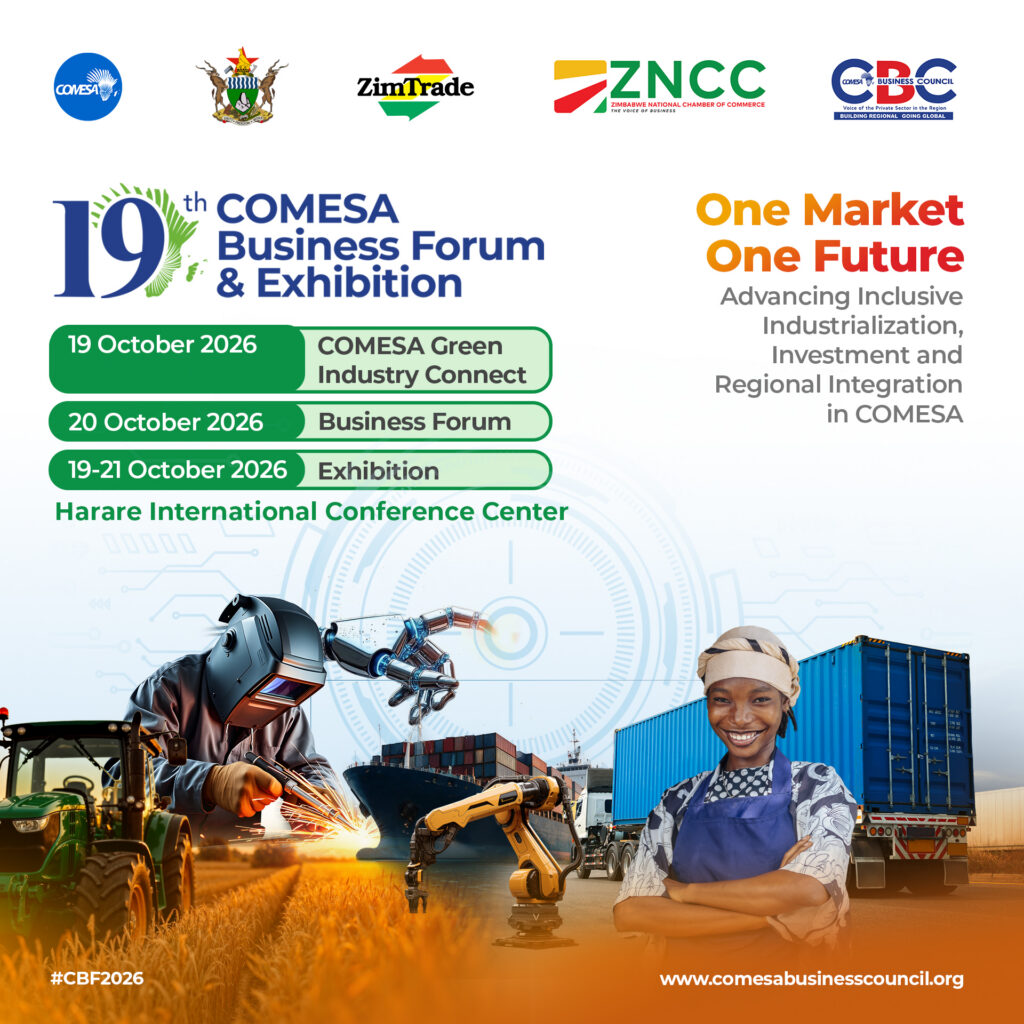
WE, THE REGIONAL BUSINESS COMMUNITY, under the umbrella of the COMESA Business Council (CBC), hereby present the COMESA Business Declaration 2026, adopted at the 19th COMESA Business Forum and COMESA Green Industry Connect in Harare, Zimbabwe, on the 19th and 20th October 2026, on the margins of the 25th COMESA Summit, under the theme: “One Market, One Future: Advancing Inclusive Industrialisation, Investment and Regional Integration in COMESA.”
Affirming that COMESA’s future depends on converting its market size, resources, enterprise base and regional institutions into a competitive, inclusive and sustainable industrial economy: moving from commodity dependence to value addition, from fragmented markets to functioning regional value chains, and from limited access to finance to investment at scale for SMEs, women, youth and informal enterprises;
Congratulating His Excellency Emmerson Dambudzo Mnangagwa, President of the Republic of Zimbabwe, and the Government and people of Zimbabwe for hosting the Forum, the COMESA Green Industry Connect and the COMESA Multi-Sectoral Trade Exhibition;
Further expressing our gratitude to the COMESA Secretariat, COMESA Institutions, co-conveners ZimTrade and the Zimbabwe National Chamber of Commerce (ZNCC), and all partners and sponsors for their support in delivering one of the most successful editions of the Forum, marked by high-level engagement, strategic regional and international partnerships and a vibrant exhibition of regional and national enterprises, in advancement of a business-led regional integration agenda;
Recognising that inclusive industrialisation requires an enabling ecosystem of reliable energy, modern logistics, harmonised standards, predictable regulation, skills development, access to finance and investment, market and trade infrastructure, technology transfer, regional procurement and circular-economy solutions;
Further affirming that the private sector is a central partner in realising One Market, One Future, and that deeper regional integration must deliver jobs, competitive enterprises, diversified exports, resilient supply chains and improved livelihoods;
WE HEREBY DECLARE THE FOLLOWING CALLS TO ACTION:
1. Build Competitive Regional Value Chains
- Coordinate industrial policies and co-invest in regional processing hubs, agro-industrial parks and shared infrastructure in priority value chains, including agro-processing, horticulture, coffee, leather and pharmaceuticals, backed by incentives that reward investment in machinery, technology and skills.
- Integrate SMEs and youth-led enterprises into regional supply chains through market intelligence, e-markets for regional sourcing, anchor-buyer and out-grower models, SME clusters, and shared logistics, warehousing and aggregation centres.
- Create seamless and fair markets through mutual recognition of standards and conformity assessment, green lanes for certified regional goods, the Simplified Trade Regime, single windows and coordinated border management, underpinned by effective competition policy.
- Resolve every non-tariff barrier reported through the COMESA–EAC–SADC online mechanism within agreed timelines, with clear milestones and designated responsible institutions, including measures that Member States apply to their own exporters.
- Enable a transparent regulatory and enabling business environment to attract investment. Adopt Good Regulatory Practices: scientific studies, regulatory impact assessments, inclusive consultation, standing public-private engagement, policy roadmaps, harmonised standards, and predictable transition periods, particularly in the manufacturing sector.
- Align national policies and standards with regional frameworks and best practices, harmonizing definitions and product classifications to strengthen intra-COMESA trade.
2. Mobilise Investment and Finance at Scale
- Establish national and regional credit guarantee schemes and blended finance facilities with development finance institutions, so that lenders move from collateral-heavy lending to risk-sharing for viable SMEs.
- Mobilise African capital through the TDB Group, Afreximbank, ATIDI and other financial institutions to provide long-term financing for regional industry, infrastructure and value chains, leveraging pension funds, diaspora capital, private equity and impact investors. Expand risk-sharing mechanisms for SMEs, including alternative credit scoring, partial credit guarantees, supply-chain and invoice financing, warehouse receipt systems, trade credit insurance, and SME capital-raising platforms.
- Strengthen project preparation and investment-readiness support so that SME and infrastructure projects reach financial close and expand local-currency lending and settlement through REPSS and PAPSS to reduce foreign-exchange risk.
3. Advance Green Industry and Circular Value Chains
- Develop harmonised COMESA standards for circularity, recycling, refurbished goods and secondary materials, including a phased approach to extended producer responsibility.
- Create dedicated finance windows for circular SMEs, including blended finance, guarantees and working capital, and strengthen skills to meet international requirements on sustainable packaging, traceability and environmental performance.
- Scale the regional leather value chain from raw hides and livestock by-products to finished regional products and brands, supported by traceability and regional procurement.
4. Strengthen the Digital Backbone for One Market
- Accelerate interoperable digital trade systems, including electronic certificates of origin, national single windows, digital customs, the COMESA Yellow Card and mutual recognition of digital documents.
- Harmonise digital public infrastructure, including digital identity, e-signatures, data protection and cross-border data flows, and connect national payment systems to enable instant, low-cost cross-border transactions.
- Prioritise solutions built by African innovators in public and corporate procurement and adopt national AI strategies and regulatory sandboxes that allow local technology firms to test and scale across regional markets.
- Establish regional arrangements for sharing satellite and earth-observation data to strengthen agricultural risk assessment, climate resilience and food security.
- Close the digital divide for women, youth and informal cross-border traders through affordable connectivity, multilingual trade platforms, youth digital ambassador programmes, cybersecurity and consumer protection.
5. Connect Corridors, People and Markets
- Modernise priority trade corridors, including Lobito, North–South, Northern, Central, Nacala, Beira, Dar es Salaam and Djibouti–Addis Ababa, through One-Stop Border Posts, electronic cargo tracking and wider use of the RCTG single-bond guarantee.
- Operationalise the COMESA Business Visa, accelerate the ratification and subsequent implementation of the COMESA Free Movement Protocol, and align national aviation policies with the Single African Air Transport Market to ease the movement of businesspeople, services and high-value goods.
- Position proven COMESA instruments, including the Simplified Trade Regime, E-Certificate of Origin, One Stop Border Posts and Regional Customs Transit Guarantee as templates for AfCFTA implementation, and engage external trading partners to support a coherent African regional integration process.
6. Champion Inclusive, Private Sector-Led Integration
- Scale business incubation, mentorship, finance and off-take linkages for women- and youth-led enterprises and connect them to cross-border supply chains and digital trade platforms.
- Foster regional champions through cross-border joint ventures and co-investment, support the implementation of the newly developed Regional Trade Promotion Strategy, and strengthen national business associations, export agencies and chambers to drive the integration agenda.
Done at Harare, Zimbabwe, on this 20th day of October 2026.
ADOPTED by the Regional Business Community, under the umbrella of the COMESA Business Council, at the 19th COMESA Business Forum.
ADOPTED as part of the Communique of the 25th COMESA Heads of State and Government Summit on the 22nd of October 2026, in Harare, Zimbabwe.